
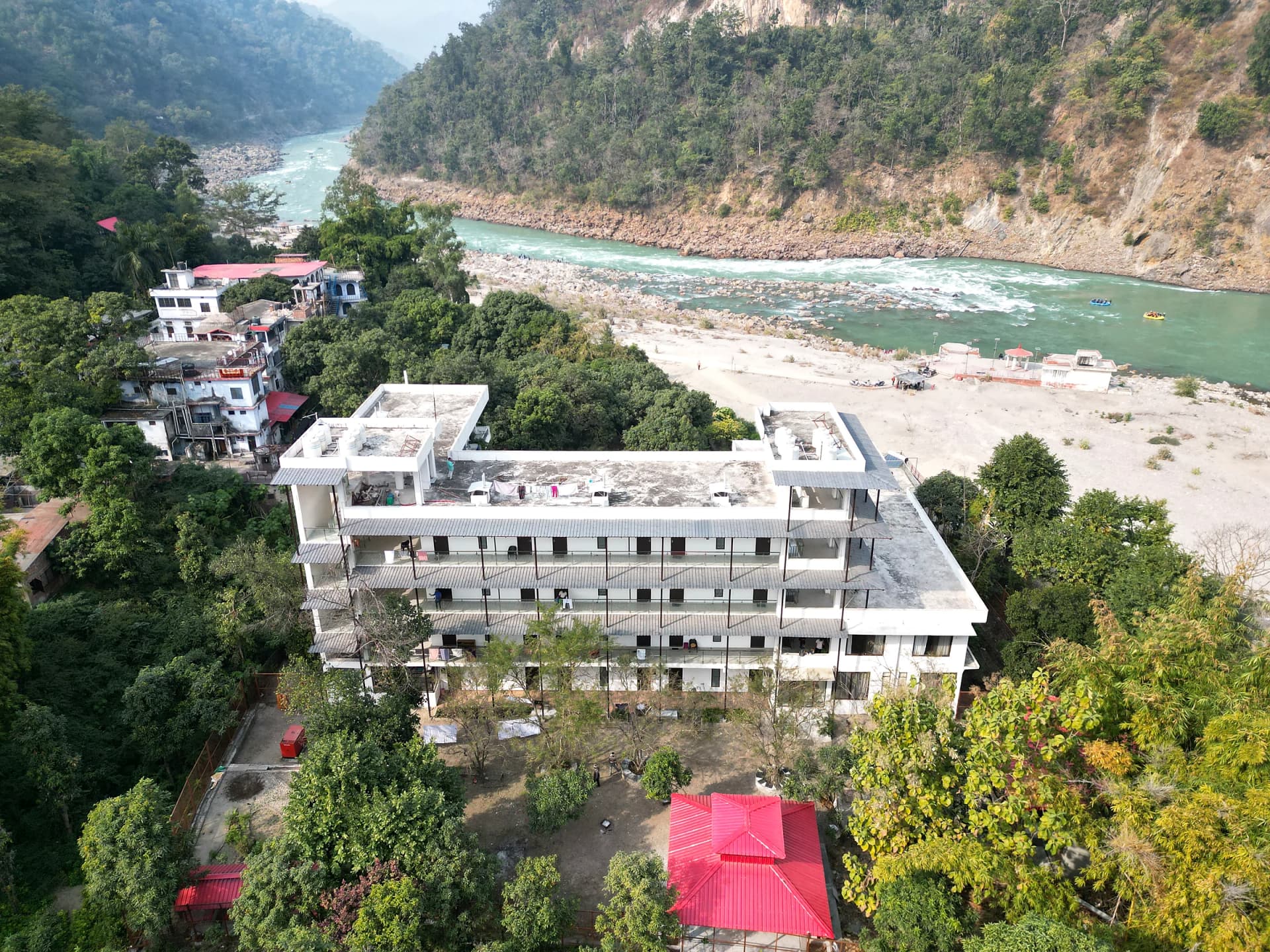
Some places make practice easier simply by being what they are. Ashram on Ganges is one of them. It sits on the banks of the Ganga about 15 km upstream of Rishikesh, where the river leaves the hills, with forest on three sides and no town around it. For more than 140 years it has been a place of practice. This article explains what the ashram is like, how a day there unfolds, and which Yogamani programmes are held there.
An ashram on the Ganga since 1885
Ashram on Ganges was founded in 1885, which makes it one of the oldest ashrams on the Ganga. It is an independent ashram, carried through the generations by a lineage of swamis. Yogamani does not own it: we hold our residential programmes there because the place itself supports the practice.
It is a working ashram, not a resort. The buildings have modern facilities, but the day follows the ashram's rhythm: early mornings, regular meals, quiet afternoons and evening rituals by the river.
Where it is, and what you hear
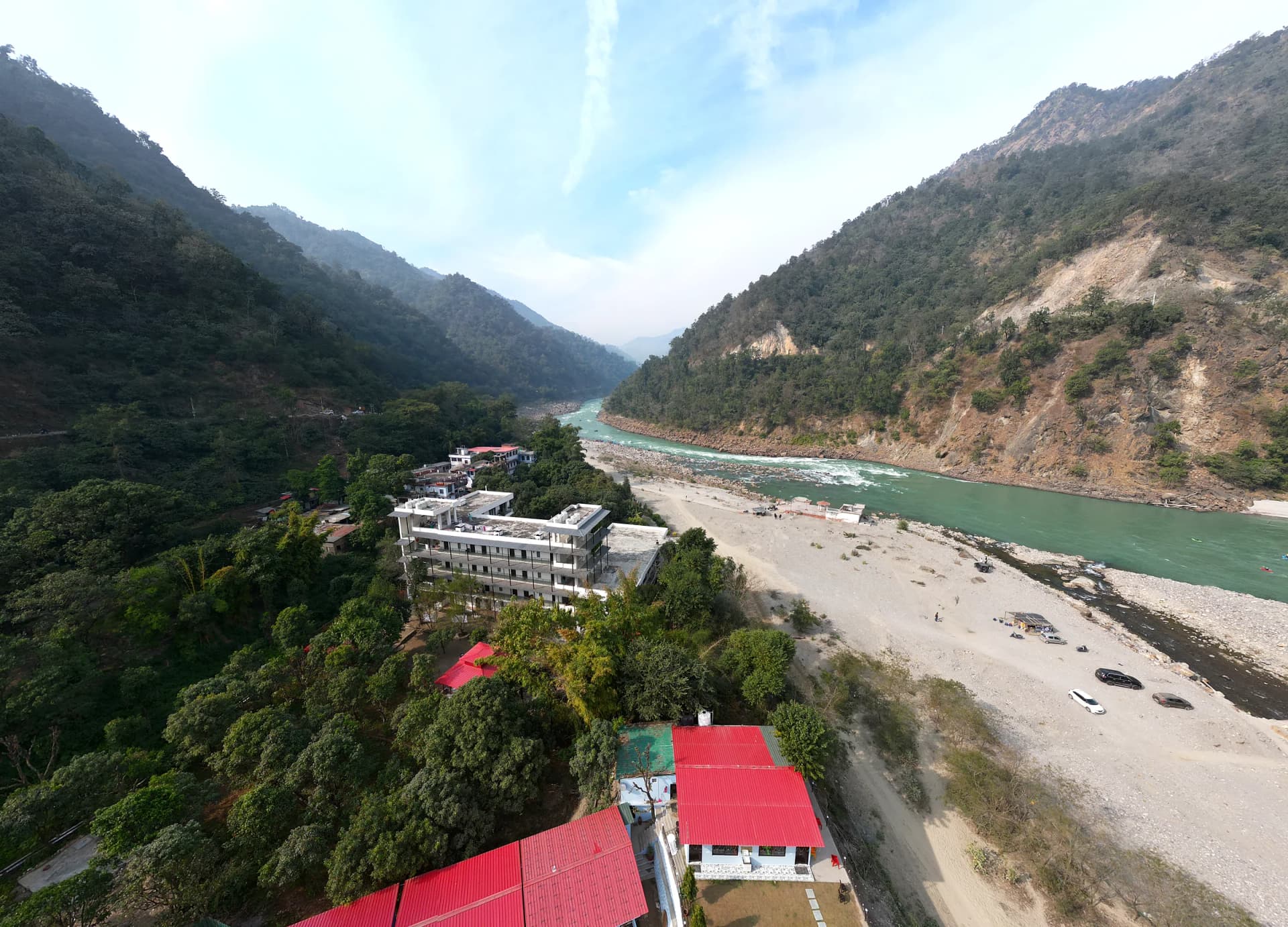
The ashram is about 15 km upstream of Rishikesh, away from the traffic and the busy streets of town. What you hear in the morning is the river and the birds. With forest on three sides and the Ganga in front, it is one of the few places near Rishikesh where the noise of the outside world falls away completely.
A day at Ashram on Ganges
Every programme has its own schedule, but a day at the ashram usually follows a similar shape:
- Early morning: practice in the yoga hall, often pranayama, meditation and asana, before breakfast.
- Morning: study or further practice, depending on the programme.
- Midday: a sattvic lunch in the dining hall overlooking the Ganga.
- Afternoon: rest, reading in the ashram library, or quiet time by the river.
- Evening: practice, then aarti and kirtan by the Ganga.
- Night: an early, quiet night, ready for the morning.
This rhythm is the real teacher. After a few days, the body begins to wake early on its own, the mind becomes quieter, and practice stops feeling like something added to the day.
Rooms, food and facilities
- Rooms: simple, clean private and shared guest rooms with attached bathrooms. Bedding and towels are provided.
- Food: three sattvic meals a day, vegetarian and freshly cooked, served in the dining hall overlooking the Ganga.
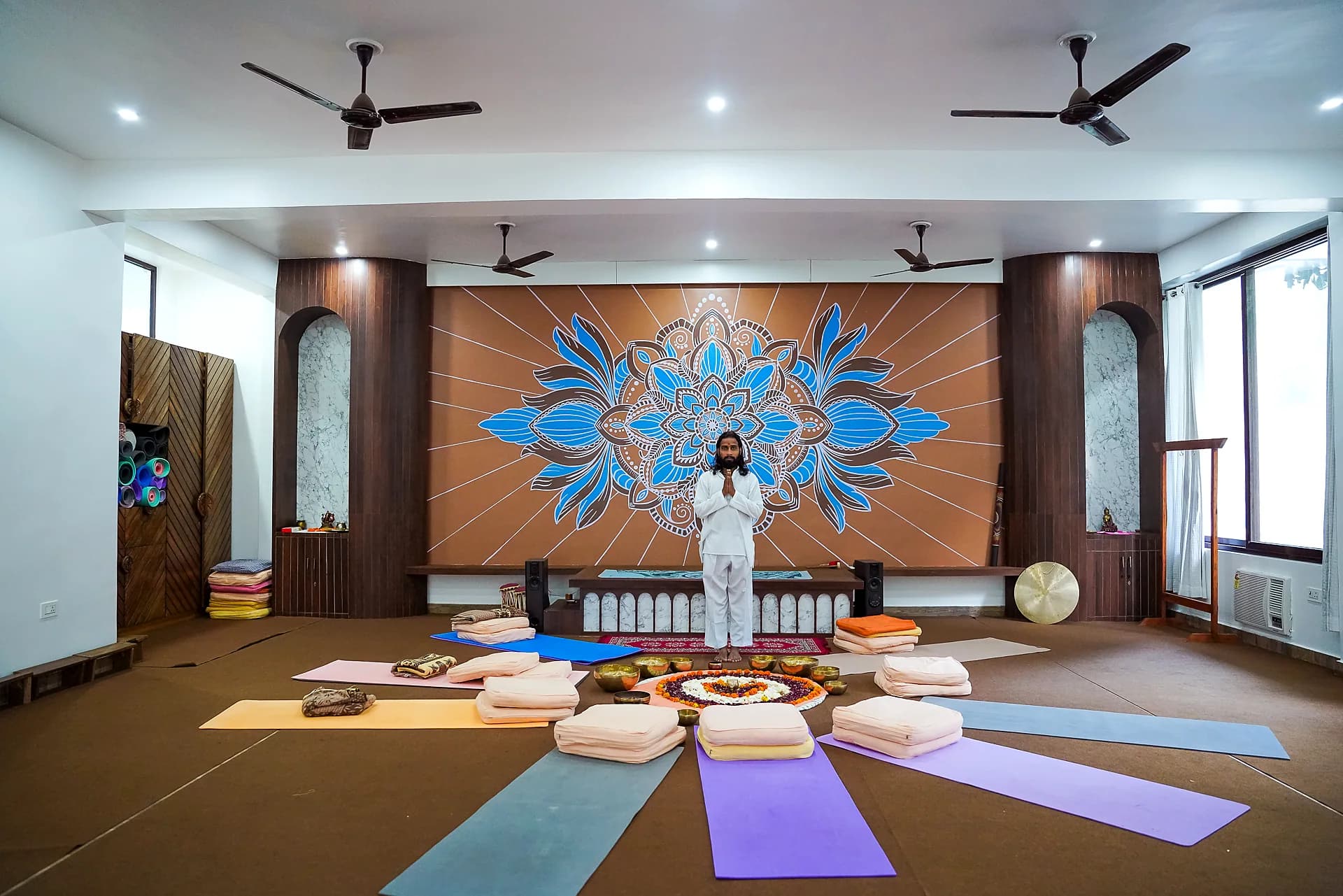
- Yoga halls: bright, spacious halls for asana, pranayama, meditation and sound.
- Ayurveda: traditional Ayurvedic massage on request, to rest the body between practices.
- Library: books on yoga, philosophy and the tradition, for quiet afternoons.
- The Ganga: aarti and kirtan by the river.
Ganga aarti and kirtan
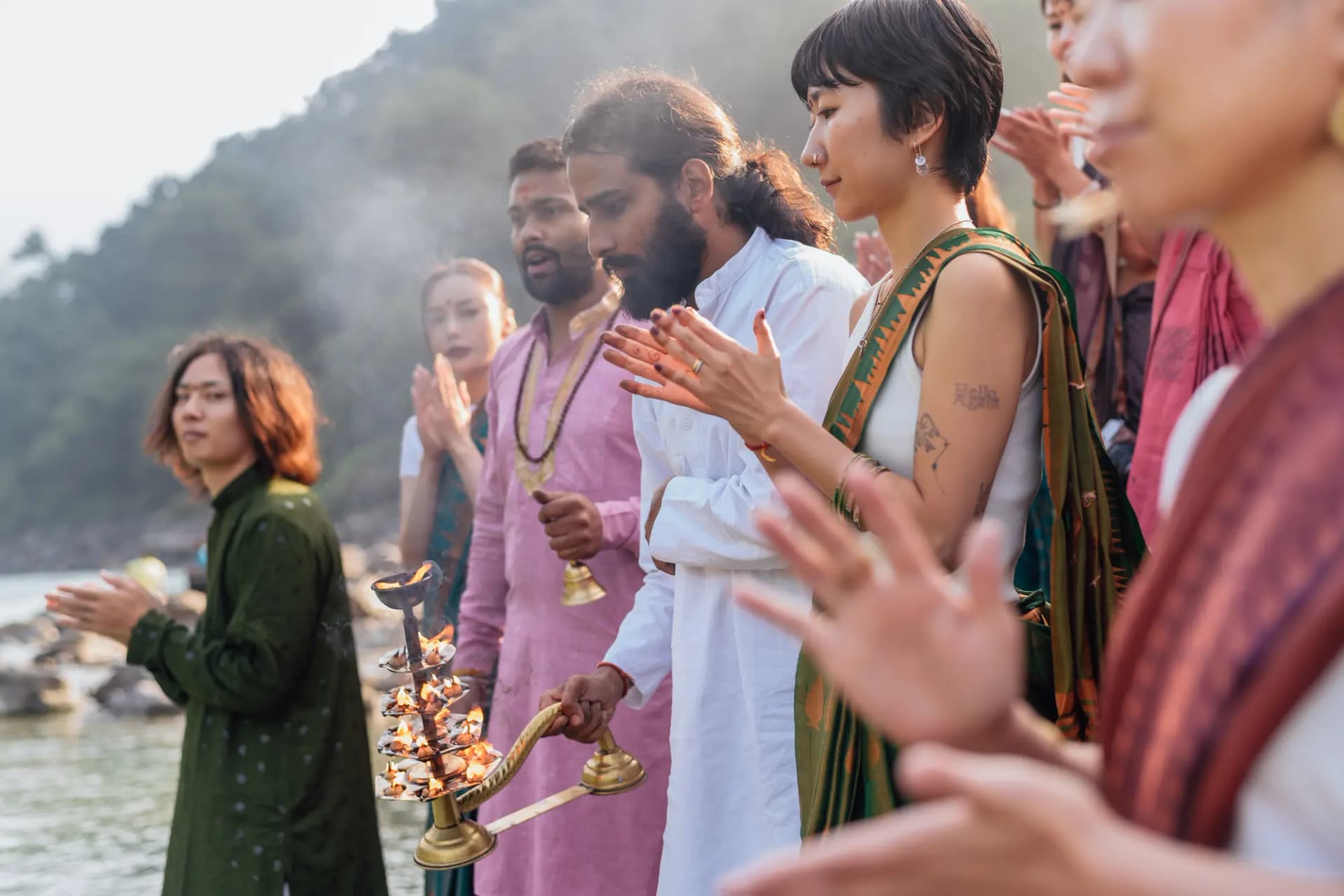
Evenings at the ashram often end by the river. Aarti is an offering of light to the Ganga, accompanied by songs; kirtan is devotional singing, simple chants repeated together. You do not need to know the words or be religious to take part. Many students say these evenings are what they remember most from their time at the ashram.
Yogamani programmes at Ashram on Ganges
Yogamani holds its residential programmes at the ashram:
- The 7 Day Yoga Retreat: a week of sadhana with daily practice, meditation, Ganga rituals, silence and ashram life, led by the Yogamani team.
- The 200 hour yoga teacher training: 60 hours online before you arrive, then 15 days in person at the ashram.
- Special editions of the 3-Day Sādhanā Retreat, on selected dates.
- Residential special editions of the Sound Healing and Nāda Yoga teacher training, and of the specialised trainings.
Daily drop-in classes and most non-residential courses take place at the Yogamani shala in Tapovan, in Rishikesh itself.
Why practise at an ashram rather than in town?
Rishikesh itself is full of life: cafés, shops, music and hundreds of yoga classes. That energy is part of its charm, but it can also make it hard to go inward. An ashram removes most of the choices that fill an ordinary day. Meals happen at set times, the halls are a short walk from your room, and there is nowhere in particular to go after dark.
Without those small decisions, attention settles on the practice. Students who come for a week often say that the first two days feel slow and the last two feel short. That shift, from restlessness to ease, is what a retreat at an ashram is for.
Silence and a break from screens
The 7 Day Yoga Retreat includes periods of silence. You do not need to have done this before. Silence at an ashram is not a test of discipline; it is a rest for the mind. Many guests also choose to keep their phones switched off for most of the day. The river, the birds and the evening kirtan turn out to be enough.
Getting to Ashram on Ganges
Most international students fly into Delhi, the main international gateway, or take a domestic flight to Dehradun, the nearest airport, and continue by road to Rishikesh. A tourist e-visa is what most international students need. Yogamani can help arrange transport from Dehradun airport or a taxi from Delhi, and shares the exact directions to the ashram when you book.
Who the ashram suits
Ashram on Ganges suits people who want to step away from town and give their practice a few undisturbed days: first-time retreat guests who want a gentle, structured introduction to ashram life, students on a teacher training who need focus, and practitioners who simply want silence and the river. If you prefer cafés and the busy yoga life of Rishikesh in the evenings, the Tapovan programmes may suit you better.

Practical notes
- The ashram follows its own rhythm: meals and quiet hours are kept, and guests are asked to respect them.
- Modest clothing is appropriate in the halls, the dining hall and by the river.
- Bring warm layers in December and January, a water bottle and a torch.
- Directions to the ashram are shared when you book a programme, and on the Yogamani pages that mention it.
A few days at Ashram on Ganges are a chance to live the practice rather than fit it into a busy day. If that is what you are looking for, the 7 Day Yoga Retreat is the simplest way to begin.